Their international cohorts include
students
from as many as 40 countries, but instead of bringing the world to
their classrooms, an increasing number of business schools send groups
of
postgraduates on overseas visits, to learn at first hand what it means to be a global citizen.
In September this year, around 200 postgraduates from
ESCP-Europe's London campus
– at the start of their two-year master's in management (MiM) programme
– spent three days at the European parliament in Strasbourg, which was
then at the end of its summer recess. They were joined by postgraduates
from the business school's other European campuses – Paris, Berlin,
Madrid and Turin – making a total of 834 students.
After learning
from officials how the European parliament worked, the students took
part in role-play exercises in which they debated the EU's proposed
financial regulations and banking union. Working in multicultural teams,
they practised soft skills – such as collaboration, negotiation and
chairing meetings – as they took on the roles of members of the
European parliament, policymakers and lobbyists.
"We call our
visit an immersion seminar," says Patrick Gougeon, director of the
Paris-based school's London campus. "The aim is to reinforce the
students' knowledge of the EU and its institutions, and to develop their
reflection concerning the European challenges."
Overseas study
visits now often include a hefty dollop of social responsibility. Field
trips to developing countries are more popular than ever and present an
opportunity for postgraduates to work with NGOs, helping small
businesses and social enterprise. For the past five years, students on
ESCP-Europe's master's in marketing and creativity have raised money to
go to Uganda, where they have helped local charities with their business
plans.
Cranfield School of Management
has seen a switch away from study tours to major growth markets – such
as China and Brazil – towards field trips to developing countries. This
year, around half of all MBA students volunteered to work in Uganda,
Egypt, Ghana, Mongolia and Nepal. Lasting 10 days in June – and
co-ordinated by Cranfield and the charity
Challenges Worldwide – the trips take place towards the end of the course.
"MBA
students can apply their knowledge to help small businesses in the
developing world to structure their ideas and meet some daunting
challenges. This is no easy option. There is real value in it for both
parties," says David Simmons, Cranfield international director.
US
postgraduate and former teacher Evan Schiff was one of a group of six
sent to Mongolia. "When I called my parents in the States, they said,
'Mongolia? Where's that, again?'"
While most of the group set to
work in Ulan Bator, Schiff and a colleague – together with a translator
and a representative from international development NGO Mercy Corps –
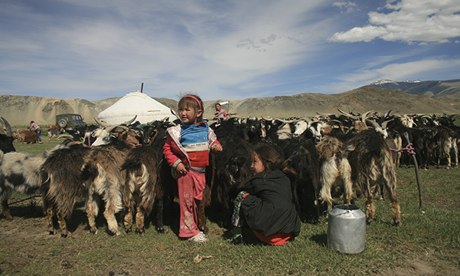
flew a further 1,500km to a mountainous region in the west of the
country. "We landed on a dirt strip in the middle of nowhere. And stayed
in a village with no clean running water or electricity."
Schiff
talked to a producer of yak's-milk yoghurt, a local business adviser and
a trader in wool. Tact, respect for cultural differences and an ability
to relate to people were much-needed qualities. "If I asked them to
tell me how much they had sold the previous week, and then repeated the
question, I would get three or four different answers."
By the end
of 10 days, Schiff had demonstrated the value of simple record keeping.
He had also learned a lot. "I was inspired by the way these businesses
rose to the challenges they faced. I will remember the lessons I learned
in my new adventure education company, Travelling Classroom."